
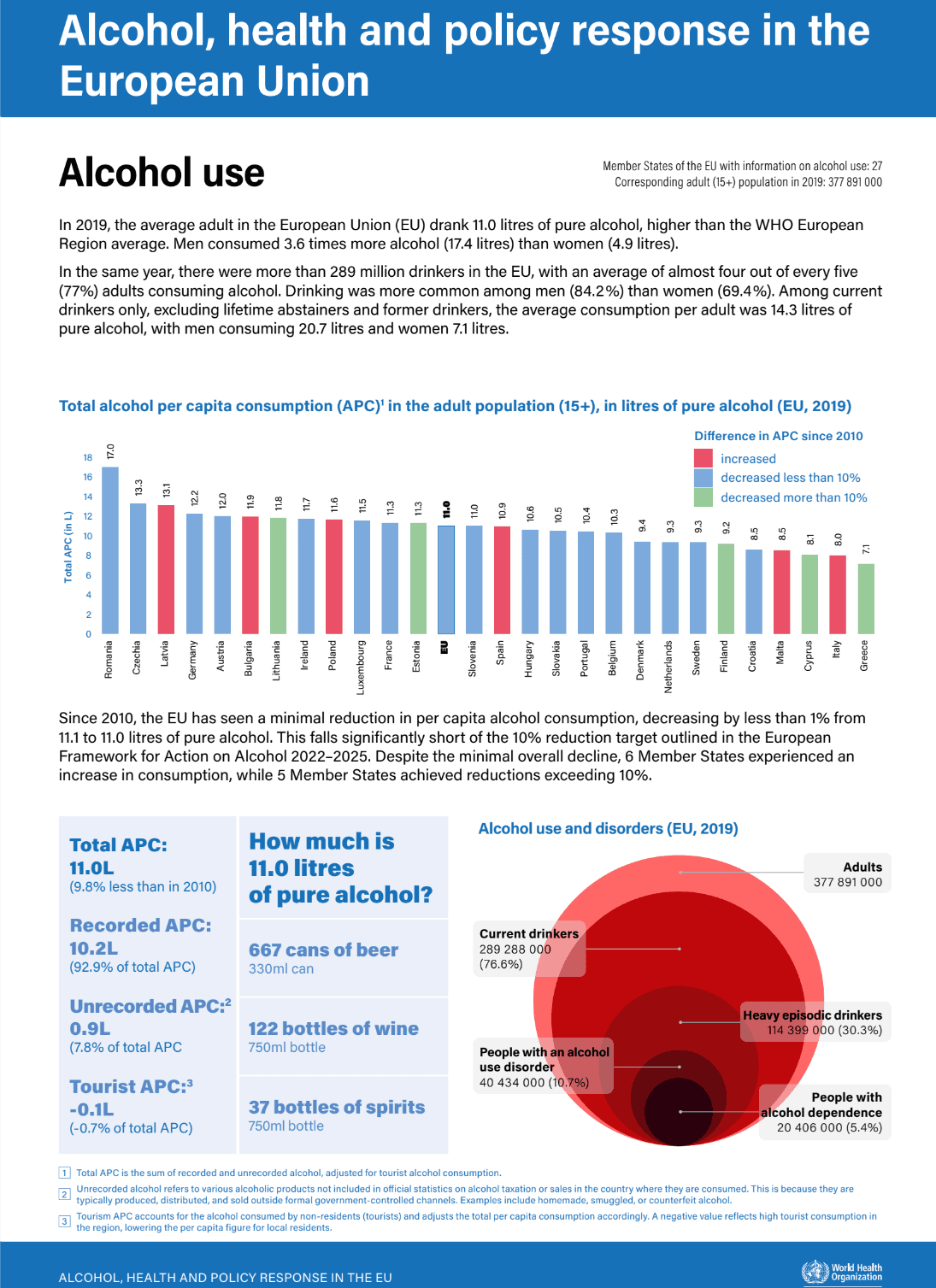
Alcohol, health and policy response in the EU
Alcohol, health and policy response in the European Union in 2019
Loading...
We use cookies to analyse site usage and improve your experience. For more information on how we use cookies, please see our Terms of Use and Privacy Policy .
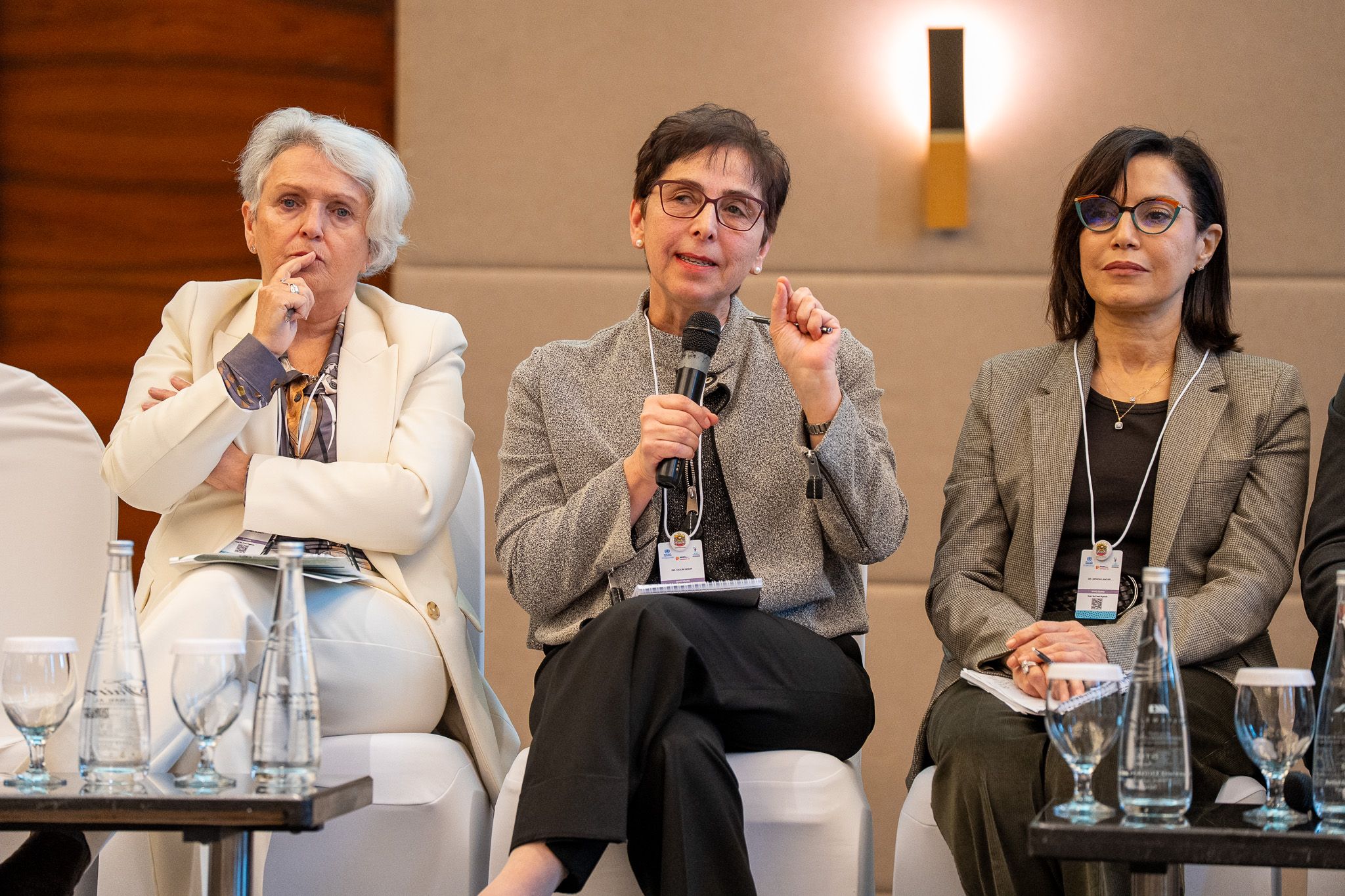
Policy makers at national, regional and local level shape the conditions for effective alcohol screening and brief interventions (SBI).
Through legislation, regulation, service organisation and financing, policy decisions determine how SBI is implemented, scaled and sustained across health, social care and workplace settings. Strong system design - including clear protocols and pathways, workforce training, stigma reduction and sustainable financing - helps reduce missed opportunities and improve coverage and quality of support.
The public health impact of SBI is strengthened when SBI implementation is aligned with evidence-informed alcohol policies that reduce availability, affordability and marketing.
Find resources for policymakers
Alcohol, health and policy response in the European Union in 2019
This policy guidance aims to support European policy-makers to improve the design and implementation of policies to reduce inequities in alcohol-related harm. The WHO European Region has the highest level of alcohol consumption and alcohol-related harm in the world. Within European countries, the burden of alcohol-related harm falls more heavily upon certain groups. Reducing health inequities is a key strategic objective of Health 2020 – the European policy framework for health and well-being endorsed by the 53 Member States of the WHO European Region in 2012. This guide seeks to assist European policy-makers in contributing to achieving the objectives of Health 2020 in a practical way. It draws on key evidence, including from the WHO Regional Office for Europe’s Review of social determinants and the health divide in the WHO European Region. It sets out practical options to reduce the level and unequal distribution of alcohol-related harm in Europe, through approaches that address the social determinants of alcohol misuse and the related health, social and economic consequences.
The technical package for the SAFER initiative focuses on five key alcohol policy interventions that are based on accumulated evidence of their impact on population health and their cost-effectiveness. Further, the SAFER initiative recognizes the need to protect public health-oriented policy-making from interference by the alcohol industry, as well as the importance of a strong and sustainable monitoring system to ensure accountability and track progress in the implementation of the SAFER interventions. This SAFER technical package is aimed at government officials with responsibility for developing policy and action plans to reduce the harm done by alcohol. Given that alcohol-related harm extends beyond public health, and that preventing and reducing such harm requires multi component action that involves many stakeholders, this guidance should also be of use to those working in sectors other than health
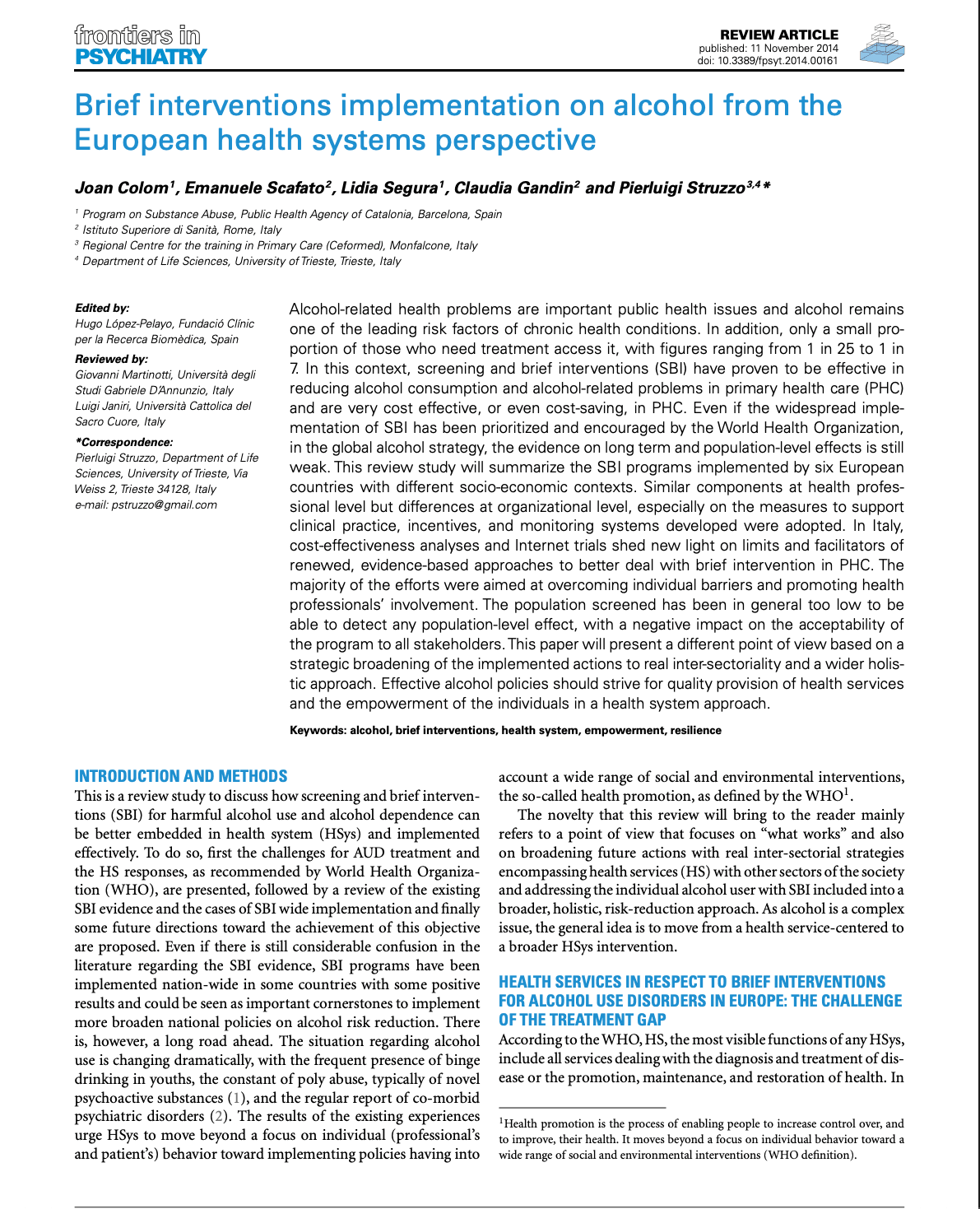
Alcohol-related health problems are important public health issues and alcohol remains one of the leading risk factors of chronic health conditions. In addition, only a small proportion of those who need treatment access it, with figures ranging from 1 in 25 to 1 in 7. In this context, screening and brief interventions (SBI) have proven to be effective in reducing alcohol consumption and alcohol-related problems in primary health care (PHC) and are very cost effective, or even cost-saving, in PHC. Even if the widespread implementation of SBI has been prioritized and encouraged by the World Health Organization, in the global alcohol strategy, the evidence on long term and population-level effects is still weak. This review study will summarize the SBI programs implemented by six European countries with different socio-economic contexts. Similar components at health professional level but differences at organizational level, especially on the measures to support clinical practice, incentives, and monitoring systems developed were adopted. In Italy, cost-effectiveness analyses and Internet trials shed new light on limits and facilitators of renewed, evidence-based approaches to better deal with brief intervention in PHC. The majority of the efforts were aimed at overcoming individual barriers and promoting health professionals’ involvement. The population screened has been in general too low to be able to detect any population-level effect, with a negative impact on the acceptability of the program to all stakeholders. This paper will present a different point of view based on a strategic broadening of the implemented actions to real inter-sectoriality and a wider holistic approach. Effective alcohol policies should strive for quality provision of health services and the empowerment of the individuals in a health system approach.
A national alcohol-related harm awareness day, week, or month is a public health initiative can raise awareness of the health, social, and economic harms caused by alcohol and to support prevention efforts. They provide opportunities for public education and engagement among different population groups and can strengthen national commitment to reducing alcohol-related harms. This comparative overview is based on the WHO Global Survey on Progress with SDG Health Target 3.5 (2023) and shows whether countries in the WHO European Region have such initiatives in place, highlighting differences in public health awareness efforts across the Region.
| Andorra | Yes |
| Armenia | No |
| Austria | Yes |
| Azerbaijan | Missing data |
| Belarus | Yes |
| Belgium | Yes |
| Bulgaria | Yes |
| Croatia | No |
| Cyprus | Yes |
| Czechia | Yes |
Page 1 of 5